

FMA CEO on leave
The FMA has been thrown into further turmoil with its chief executive taking “a period of leave from today”.
Wednesday, July 29th 2026, 7:04PM  6 Comments
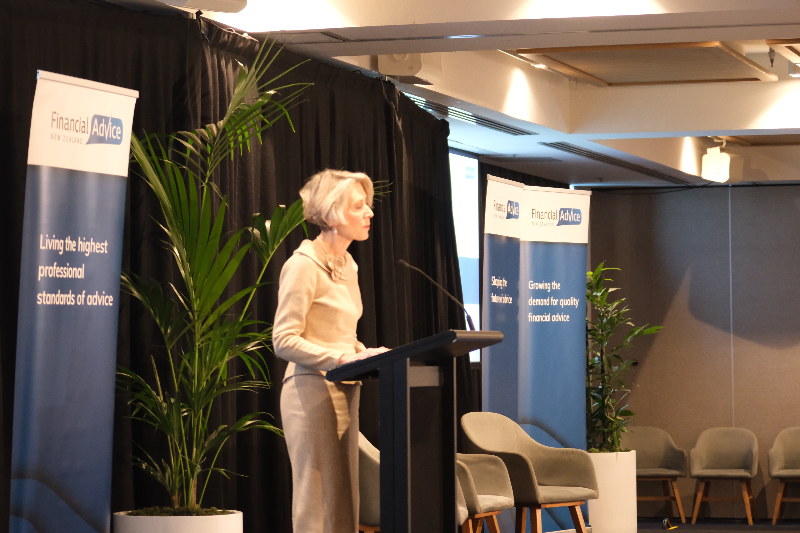
Samantha Barrass addresses the FANZ Summit two days before being put on leave. (Image: Good Returns)
The bombshell announcement comes hard on the heels of former chairman Craig Stobo stepping down and questions over the future of the current CEO Samantha Barrass.
In a statement the board says Barrass is on leave as it begins an urgent assessment of workplace culture concerns.
This week Stuff revealed that allegations had been raised by multiple former employees around “cultural concerns.”
“The FMA Board has recently become aware of cultural concerns at the FMA and is assessing the matters raised as a matter of urgency.”
With Barrass on leave board member Alastair Hercus will step into the role of interim Chief Executive.
In an unrelated announcement in May, the FMA said Barrass would not seek re-appointment at the end of her five-year term in January 2027.
A former senior employee, who was made redundant when Barrass took over, told Good Returns about their concerns about how the regulator was being managed.
"Morale is rock bottom with utter confusion. There’s no substance behind the rhetoric-externally or internally. When staff can’t deliver they’re blamed for letting her down. Having to make folk redundant due to financial mismanagement is an utter disgrace.
"What a shambles. I feel sorry for the good people that remain who are too afraid to speak up."
| « Milford lifts fee income despite earning no performance fees | Michael Lang now controls more than 75% of NZ Funds Management » |
Special Offers
Comments from our readers
They introduced licencing to the financial adviser industry but never thought it through.
Most mortgage advisers are currently being overregulated which in turn is affecting consumers using their services and here’s why.
Let take the average Mortgage adviser that has their own FAP licence.
99% of these advisers will be compliant with their FAP license requirements and taking time and effort and expense to meet their FAP requirements which is great and better for the industry.
But because the banks and lenders will only let a select few have Header agreements or Header aggregation FAPs with them directly all the other FAP’s s are forced to belong to one of these header FAP’s to get access to lender products.
These Header FAPs are forcing all its members (including FAP licence holders) to be compliment under their header FAP essentially treating other FAP licence holders as authorised bodies under the group licence, and one group recently increased its fees for FAP licence holder members only, stating if adviser chose to not cancel their own FAP licences and go under the group one, they will pay higher membership fees. Monopoly?
What does this do? it basically doubles the amount of regulation a single FAP licence holder has to do as they are repeating regulation requirements twice under their own licence and then again under the header group licence.
This may not be what the FMA intending licencing to be but for most FAP license holders they are wondering now why they all just didn’t go under one header licence and be done with it then the FMA would only have a small few FAP licences which in turn would defeat the whole licencing function.
How does this effect the consumer?
Over regulated Advisers have to pass a lot of this onto the customers they engage but bank staff do not, so is it in the banks best interest to push more regulation requirements onto advisers? maybe. Some customers rather that read and compete a 42-page form will just go direct to a bank branch with no advice given.
The Master/header FAP agreements groups have with lenders is their sole strong hold /monopoly over mortgage advisers.
Dealer groups /master FAP holders, also create behind the scenes referral structures based on bulk referrals by their members, where the groups receive back-office referral income that is not disclosed to the advisers let alone the public or the customer , these include forced training platforms , file reviews , PI insurance schemes , house and personal insurance referrals , and kiwi saver schemes all owned by groups or members of and their mates, of, with dealer groups clipping the ticket.
Advocates for advisors I think not , and where is the FMA?
Question. Why would any financial adviser currently tolerate the FMA reviewing his or her own business when the FMA doesn’t even appear able to run its own house professionally? Advisers are all now expected to run and operate their businesses to a much higher standard? Does the same not also apply to the regulator itself?
The issues present at the FMA indicate that it’s time for the government to overhaul Wellington’s public service. No more beating about the bush. The Public Service Commissioner has publicly stated Wellington’s public service is no longer fit for purpose and the dysfunction present at the FMA indicates that it’s time for our politicians to act. The NZ taxpayer demands it especially when the current FMA chief executive is on income exceeding $640,000 annually making her one of the country’s highest paid public servants.
Is it any wonder that we currently have salespeople in this industry masquerading as financial advisers who’ve been allowed to continue providing financial advice while a massive conflict of interest is present. The FMA has dropped the ball on this subject and it’s clear why now they have failed to protect consumers. Their own house is a shambles. This is not good enough sorry and in an election year voters will be watching closely to see what action the government takes.
Since March 2021 "financial adviser" has been a legal designation, not a job title, carrying a duty to give priority to the client's interests. Yet the word has escaped its definition, with a salesperson tied to a single manufacturer dressed in the language of advice. The subtler case is the practitioner tied to a single investment philosophy, for whom every client in every circumstance somehow arrives at the same answer — a conflict that is intellectual rather than commercial, and so triggers no disclosure at all.
The regime's answer is disclosure, which assumes a first-time buyer of advice — anxious, deferential, slightly embarrassed at how little they understand — will read and understand a scope-of-advice statement like a compliance lawyer.
Consumers hear "adviser", they hear "your interests come first", and they conclude a market was searched. So the question is not "was this disclosed?" but what did the consumer reasonably understand to have happened? A conflict is not managed because it was mentioned; it is managed when the person bearing the risk knows they are bearing it.
The most elegant description of what you are talking about was retired Chief Justice of Australia speaking at a conference in Australia in 2009.
Sir Anthony Mason said "our system of regulation proceeds on the footing that the adviser may be a product seller. Indeed our system enables the product seller to adopt the guise of a financial adviser and endows that disguise with the aura of legitimacy by calling him a "licensed financial adviser.
The sales vs advice distinction was lost a long time ago.
I believe the final straw happened at an industry/professional association meeting with MBIE where I was arguing very strongly for such a divide - those who were there might recall my Venn diagram.
But I got completely white anted by the PIA rep, and the FPIA reps were so tied up in their wish to appease the officials in the hope they would meke them the self reluator that they chose not to engage in the inter-association stoush.
My subsequent discussion with a senior MBIE person told me we lost the sales vs advice argument that day because of an advisor body representative exhortations.
Sign In to add your comment
|
|
Printable version |
|
Email to a friend |


PS I've never met the lady nor even heard her speak in person. But where there are flames, there is normally fire.